
Freeborn County Probate Court
Freeborn County probate matters use the Probate Division of Freeborn County District Court. Minnesota uses District Court as the trial court for civil, family, probate, juvenile, criminal, and traffic case types, so Freeborn County probate matters are handled at the same 411 S. Broadway courthouse in Albert Lea as other District Court records. Court administration is the local counter for probate files, certified copies, older records, and documents that are not available remotely.
The Minnesota Judicial Branch defines probate as the legal process for getting court authority to transfer property after death. A petition or application is filed, and a personal representative is appointed by court order. The personal representative collects, inventories, and appraises assets; protects estate property; pays debts; and distributes what remains to the proper parties. Probate can be simple or contested depending on assets, debts, family issues, creditor claims, or whether a valid will exists.
The Minnesota probate, wills, and estates overview explains the statewide probate process that applies in Freeborn County District Court.
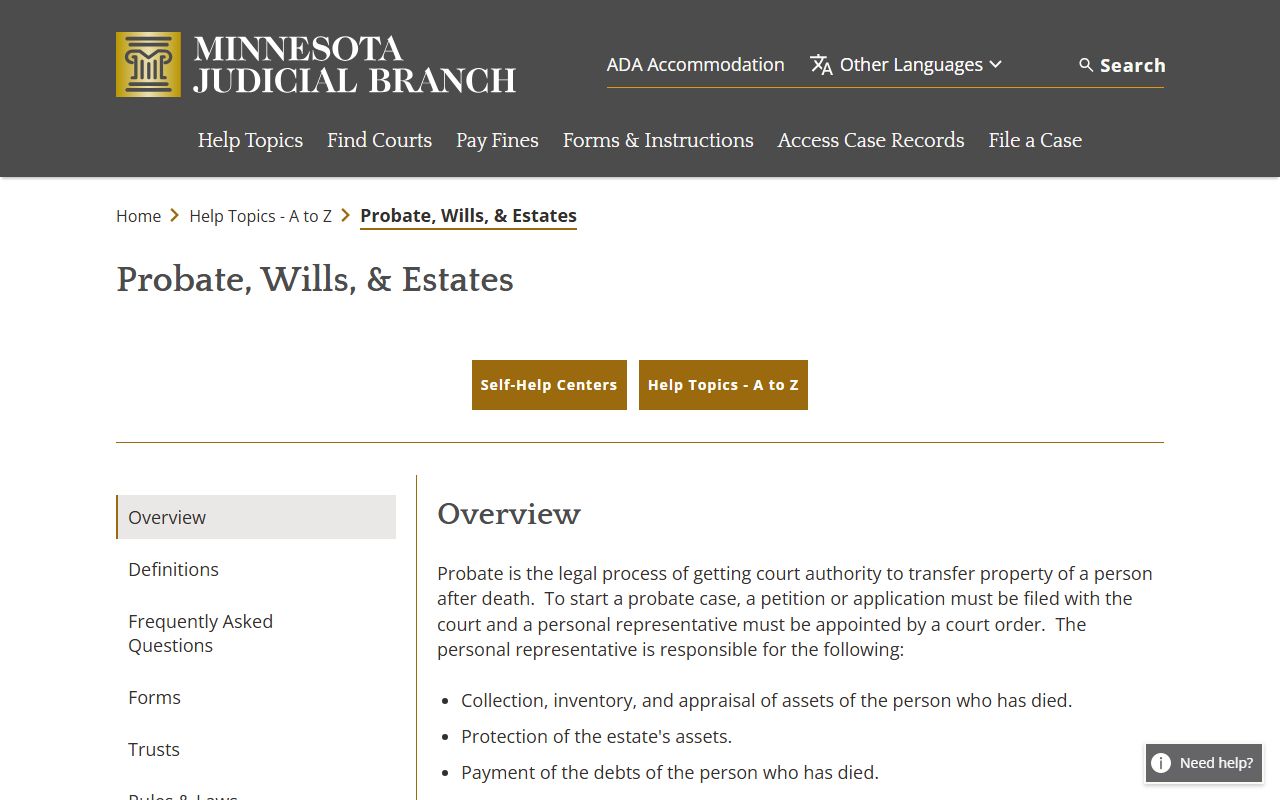
The probate overview image anchors the local page in the statewide Judicial Branch process used by Freeborn County.
Probate Terms Defined
Probate filings use terms that can be hard to read without context. These plain-English definitions help separate the people, documents, and court roles that appear in a Freeborn County probate file.
- Testator
- A person who made a will.
- Executor
- A person named in a will to carry out the will. Minnesota probate records often use personal representative as the working court term.
- Personal representative
- The person appointed by court order to handle estate assets, debts, notices, and distribution.
- Intestate
- Dying without a valid will, so property passes under state law rather than under a will.
- Guardianship
- A court case about authority to make personal or care decisions for another person.
- Conservatorship
- A court case about authority to manage another person's money or property.
Informal and Formal Probate
Minnesota distinguishes informal probate from formal probate. Informal probate is used when an application asks the court to appoint a personal representative without a hearing in less complicated situations. Formal probate uses a petition and a hearing before a judge. Formal probate may be needed when there are disputes, unclear documents, notice issues, questions about who should serve, or other facts that require judicial review.
The personal representative's core duties are similar once appointed. The representative must identify estate property, protect assets, deal with creditor claims, pay debts and taxes, and distribute the remaining property to heirs or devisees. The court file may include an application or petition, order appointing the representative, letters, inventory, accountings, notices, closing documents, and other filings. The exact record contents depend on case type and whether the matter is supervised, contested, or administratively handled.
Search Freeborn Probate Cases
Use Minnesota Court Records Online Case Search to search probate cases by party or decedent name, personal representative, petitioner, interested party, or case number. Select Freeborn County when narrowing the search. Probate case numbers may use the PR case type code. When a case number is known, use MCRO Document Search to look for public documents that can be accessed remotely.
- Search MCRO by name or case number and select Freeborn County.
- Look for probate or PR case-type indicators when reviewing results.
- Open the Register of Actions for public case events and filing history.
- Use Document Search by case number for remotely available public documents.
- Contact Freeborn County court administration for older, restricted, or non-remotely available documents.
The Minnesota probate forms page provides statewide probate forms used before and during probate filings.
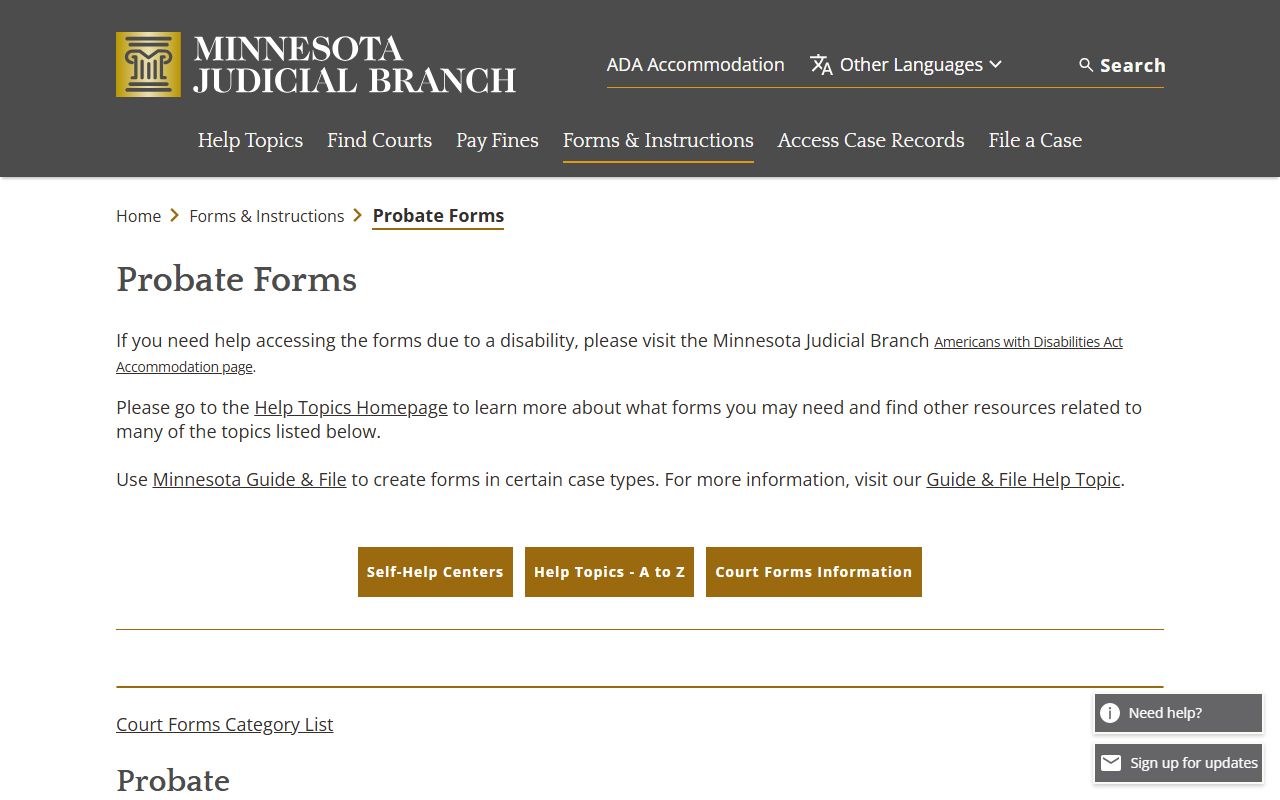
The probate forms screenshot shows the official forms path that often leads to a Freeborn County probate case filing.
Freeborn Probate Search Fields
MCRO has separate search paths for cases and documents. Case Search can find a probate case by name or case number, while Document Search requires the case number. Use the table as a practical field inventory for Freeborn County probate searches.
| Field Label | Type | Required | Options / Format Notes |
|---|---|---|---|
| Name | Text | Conditional | Search decedent, personal representative, petitioner, or interested party. |
| Case Number | Text | Conditional | Best if known; probate cases may use a PR code. |
| County | Dropdown/multi-select | Optional | Select Freeborn to narrow results. |
| Case type | Filter or implicit code | Optional | Probate, PR, guardianship, conservatorship, or trust. |
| Document Search case number | Text | Yes for document tab | Required to find remote public documents. |
Formal Probate, Other Probate, Guardianship and Conservatorship, and Trust documents filed on or after July 1, 2015 are among the categories MCRO says users may access or download if the documents are public and remotely available. Older documents, documents filed before July 1, 2015, and records with remote-access limits may require court administration.
Freeborn Probate Contact
There is one local District Court contact point for Freeborn County probate matters. Use court administration for filing questions, copies, certified records, older probate documents, and help identifying whether a document is available only at the courthouse.
Probate Division of Freeborn County District Court
411 S. Broadway
Albert Lea, MN 56007
(507) 668-6014
Monday-Friday, 8:00 a.m.-4:30 p.m.
Rebecca S. Mittag is listed as Court Administrator for Freeborn County District Court. The court administration role is distinct from the county Recorder, which handles marriage and land-record functions rather than probate case files.
Freeborn Probate Filing Fees
Freeborn County probate fees come from the District Court fee schedule. The first-paper fee applies to estates, trusts, guardianships, and conservatorships. Copy fees depend on whether the copy is certified, exemplified, or uncertified.
| Item | Amount |
|---|---|
| Estates, trusts, guardianships, conservatorships first paper filed | $316 |
| Deposit of wills for safekeeping | $27 |
| Certified copy | $14 |
| Exemplified copy | $14, or $28 if exemplified and certified |
| Uncertified copy | $0 |
| Forms packet 1-10 pages | $0 |
| Forms packet 11+ pages | $5 |
The Freeborn County District Court fee schedule is the official source for these local court fees.
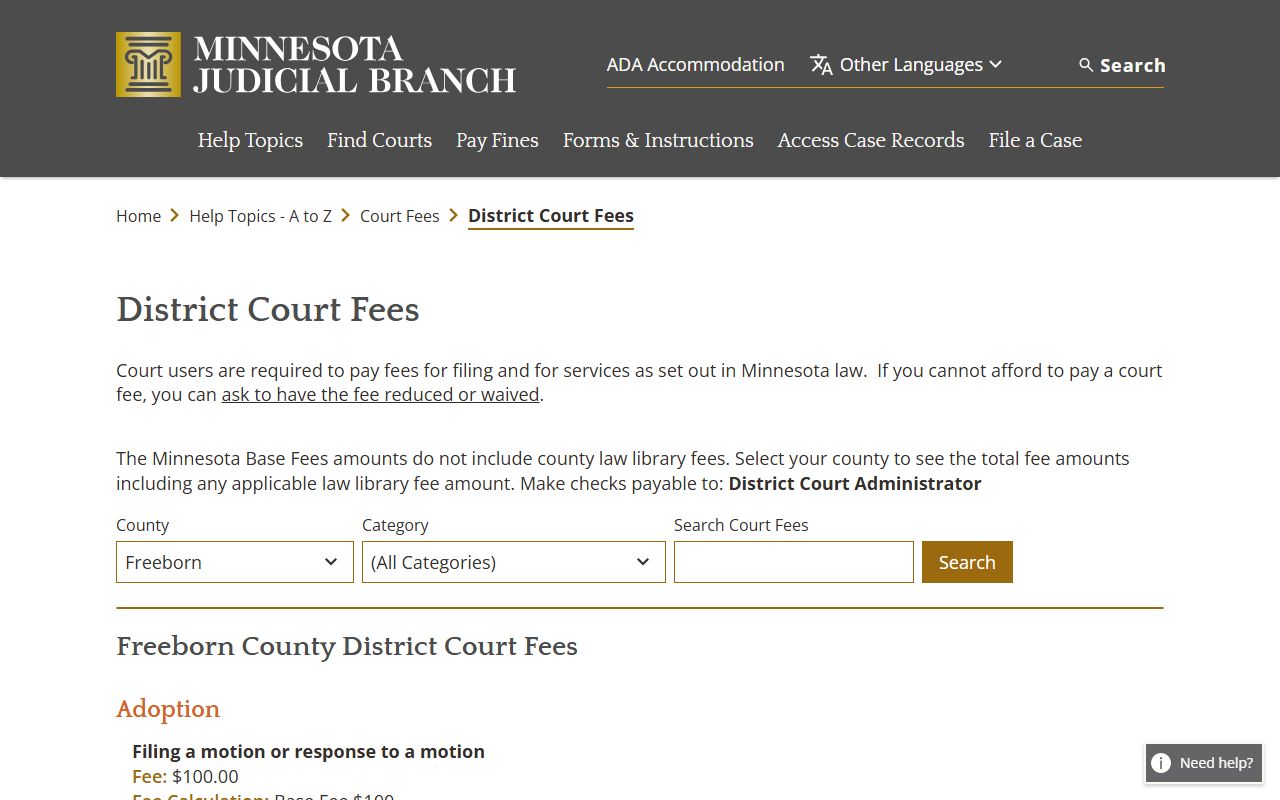
The fee schedule image is placed here because probate filing and copy costs are court fees, not Recorder fees.
What Probate Records Show
A Freeborn County probate record may show the decedent name, petitioner, personal representative, interested parties, case number, filing date, orders, letters, inventories, accountings, notices, creditor information, distribution records, and closing documents. Guardianship and conservatorship cases may include petitions, appointment orders, annual reports, accountings, medical or capacity-related information, and financial records. Trust cases may include petitions, orders, accountings, trustee information, and related documents.
Online records should be read as public access copies, not as certified proof unless the court issues a certified copy. A Register of Actions can show what happened in a case, while a document image may show the filed instrument itself. If the document is not downloadable, the Register of Actions can still help identify the exact filing to request from court administration.
Probate Copy Requests
Freeborn County probate copy requests follow the District Court copy path. Requesters can ask court administration for certified copies, exemplified copies, uncertified copies, or specific probate documents by case number. A case number is the cleanest way to request a copy, but a decedent name, petitioner name, personal representative name, and approximate filing date can help when the case number is unknown. Mail requests should identify the requested document and include requester contact information so court staff can confirm cost, payment, and delivery.
Certified copies are used when a bank, title company, agency, or out-of-county court needs official proof of a probate order or letters. Exemplified copies may be needed for some out-of-state uses because they include additional court authentication. Uncertified copies are useful for reference and research when official certification is not required. If a probate record is older, off site, sealed in part, or not remotely available through MCRO, court administration remains the fallback source.
Restricted Probate Records
Probate records are generally public unless a document is sealed or contains restricted personal information. Guardianship and conservatorship files may contain medical, financial, vulnerable-adult, or capacity-related information that is redacted, restricted, or filed in a confidential manner. Trust documents and attachments may also have access limits depending on the document and court rule. Public docket access is not the same as full remote access to every attachment.
For older probate documents, contact Freeborn County court administration. MCRO document access is limited for filings before July 1, 2015, and even newer documents must be public and remotely available before they can be downloaded. Court staff can explain copy options, certification, payment, and whether the record must be reviewed or requested at the courthouse.
Note: A visible probate case does not mean every financial, medical, or minor-related document in that file is open for remote download.