
Criminal Court Records in Freeborn County
Criminal cases filed in Freeborn County route through Freeborn County District Court, the local trial court location in Minnesota's unified District Court system. The court is at 411 S. Broadway in Albert Lea and is part of the Third Judicial District. The same District Court handles criminal, traffic, civil, family, probate, and juvenile case types, so a criminal court file is not held by a separate county criminal court or municipal court.
The record usually begins when the State of Minnesota, through the prosecutor, files a complaint, citation, or related charging document. From that point, the court record may show the case number, defendant name, charge list, hearing notices, warrants when public, plea entries, orders, sentencing terms, probation conditions, restitution, fines, and final disposition. Arrest and booking details are a sheriff or jail record; the filed court case and the outcome belong in the District Court record. For the arrest-to-charge pathway, use Arrest Records & Charges; for custody status, use Inmate Records.
The County Attorney's Office prosecutes local criminal complaints on behalf of the State. The Freeborn County Attorney is David J. Walker, and the office is also at 411 Broadway S, PO Box 1147, Albert Lea. Victims do not legally press or drop criminal charges in Minnesota; the County Attorney or an Assistant County Attorney decides whether to file, amend, or dismiss charges, while victim input may be considered.
How to Search Freeborn County Criminal Court Records
The main court search channel is Minnesota Court Records Online Case Search, commonly called MCRO. Freeborn County does not publish a separate county-built criminal case database for District Court cases. MCRO covers Minnesota District Court case records, registers of actions, hearing information, public documents available remotely, and judgment information, subject to court access rules.
- Open MCRO Case Search, accept the terms, and choose the search tab that fits the information available.
- Use the case number whenever possible, especially for a pending criminal, traffic, or petty misdemeanor case with no conviction.
- Select Freeborn County in the county filter when the goal is a local Albert Lea District Court case.
- Open the case details and read the Register of Actions for filings, hearings, warrants when public, orders, plea entries, disposition, and sentence.
- Use MCRO Document Search by case number when a public document is remotely available.
- Contact Freeborn County court administration for certified copies, older files, civil judgment certification, or documents that are public but not available online.
MCRO warns that pending criminal and traffic cases without a conviction may not return by defendant-name search. That limitation matters in Freeborn County because a new arrest can have an early court appearance before a name search reliably locates the court file. If the case number is known from a citation, jail paperwork, court notice, attorney, or prosecutor filing, search by that number first.
The Minnesota BCA Public Criminal History Search is a separate state system for public conviction history. It is useful when the question is whether a public conviction appears in a fingerprint-linked criminal history record, but it is not the full court file, not a current warrant search, and not the best source for pending Freeborn County charges.
The BCA search home page is shown in the source image from Minnesota BCA Public Criminal History Search.
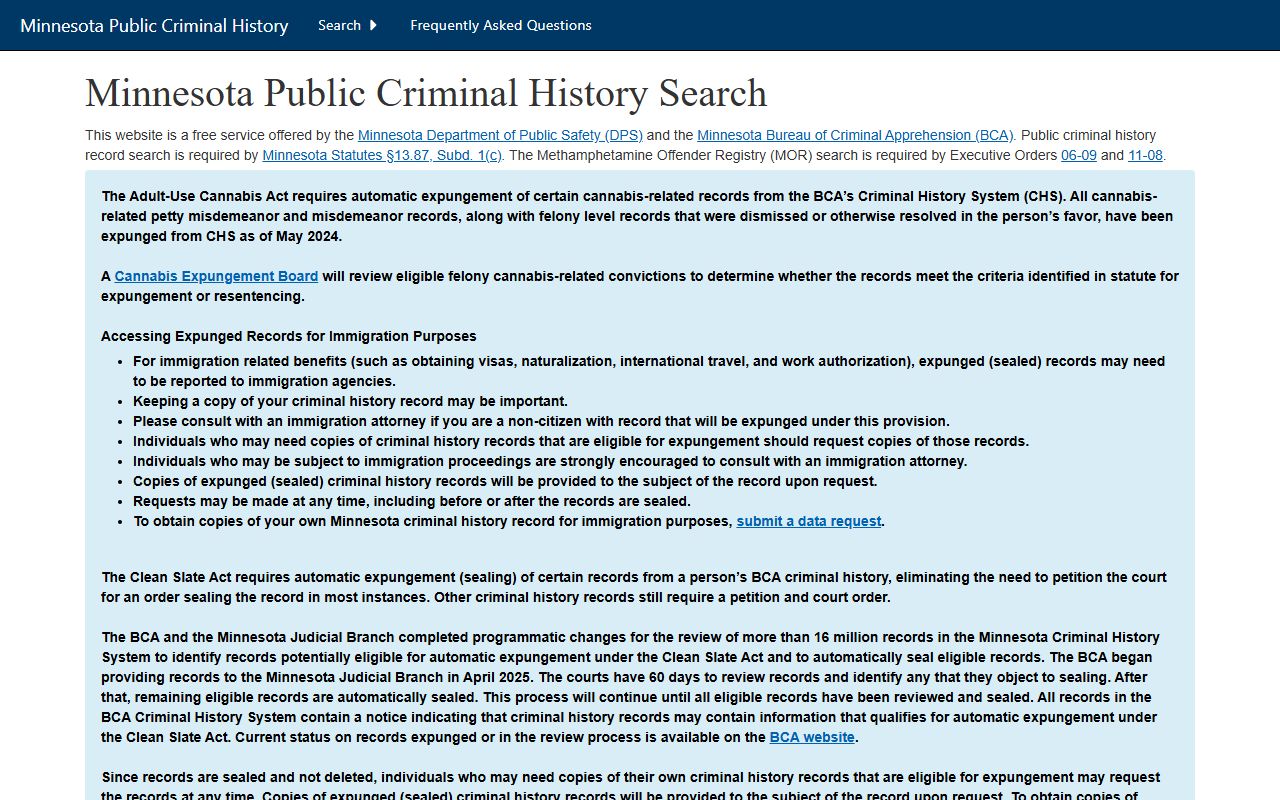
Use that system for conviction-history checks, then return to MCRO or Freeborn County court administration when the needed record is the court case file.
The BCA FAQ also explains criminal-history limits; its source image comes from the BCA Public Criminal History FAQ.
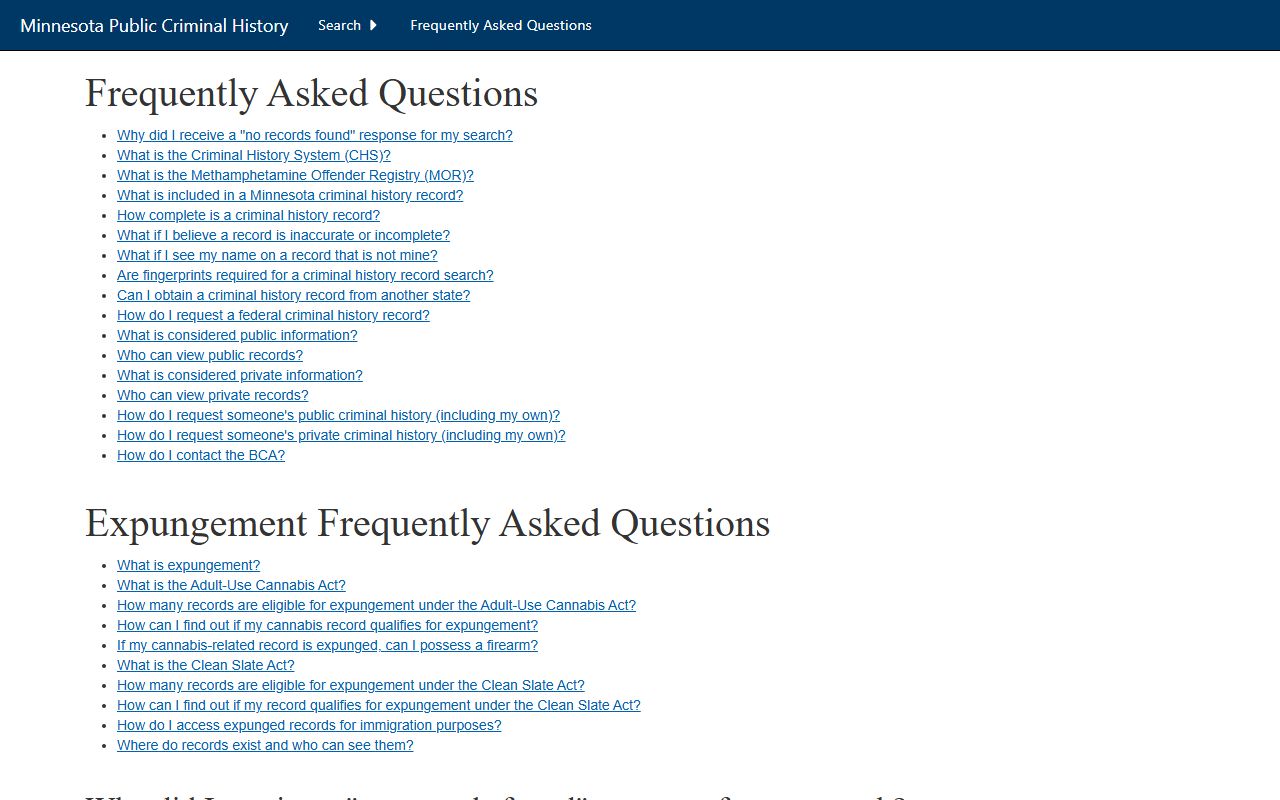
The FAQ is most helpful when comparing BCA conviction results with court records that may include dismissed charges, pending counts, or sealed material.
Stages of a Criminal Case
A Freeborn County criminal case usually moves through recognizable stages, although the exact path depends on the charge level, custody status, plea negotiations, motions, and whether trial occurs. Each stage leaves a different trace in the Register of Actions or court documents. New arrests also have a local timing rule: first appearances for new arrests are scheduled Monday-Friday at 11:00 a.m.; there is no weekend, holiday, or evening court for new arrests, and normal release after first appearance is between 2:00 p.m. and 3:00 p.m.
Case flow: Arrest or citation › Complaint or citation filed › First appearance / arraignment › Pretrial and motions › Plea or trial › Disposition › Sentencing › Probation, payment, appeal, warrant, or expungement activity.
| Stage | What Happens |
|---|---|
| Complaint or citation | The formal charging paper starts or supports the court case and lists alleged offenses. |
| First appearance / arraignment | The court addresses the charges, release conditions, counsel, bail, and future hearing dates. |
| Pretrial / motions | Attorneys may address discovery, evidentiary issues, negotiations, continuances, or dismissal requests. |
| Plea or trial | The defendant enters a plea, reaches an agreement, or proceeds to a court or jury decision. |
| Disposition and sentence | The court records dismissal, acquittal, conviction, sentence, probation terms, fines, fees, restitution, or jail credit. |
What a Freeborn County Criminal Court Record Shows
A criminal court record is read field by field. The case number identifies the file; the caption names the parties; the Register of Actions tracks court events in chronological order. Public documents may be downloadable in MCRO for some case types and dates, but courthouse public terminals and court administration can have access to public records that are not available remotely.
| Field | What It Shows |
|---|---|
| Case Number | Minnesota court file number, often with a case-type code such as CR for criminal matters. |
| Defendant | The person charged, plus party role and sometimes limited identifying information. |
| Charges | Offense names, statutory references, severity level, count numbers, amendments, and dismissals when entered. |
| Hearings | Dates, hearing type, location, judicial officer, and whether a hearing was continued, held, or reset. |
| Plea | Guilty, not guilty, plea agreement activity, or other plea entry recorded by the court. |
| Disposition | Final outcome for each count, such as guilty, dismissed, acquitted, or otherwise resolved. |
| Sentence | Jail, probation, conditions, fines, surcharges, restitution, and financial obligations where public. |
| Warrant Activity | Public entries for warrant issued, served, recalled, or quashed when the court record displays them. |
Charges vs. Convictions
A charge is an accusation filed into court. A conviction is a final legal outcome after a guilty plea, guilty verdict, or qualifying finding. Freeborn County criminal court records can show charges that were later dismissed, reduced, amended, or resolved without conviction. That is why MCRO and BCA do not answer the same question: MCRO can show case activity and charge history, while BCA public criminal history focuses on public conviction history.
| Charge | Conviction | |
|---|---|---|
| Stage | Filed accusation in a court case. | Final guilt result by plea, verdict, or qualifying finding. |
| Where to check | MCRO case record, complaint, citation, or court administration. | BCA public criminal history and the final court disposition. |
| Can change? | Yes, charges may be amended, reduced, or dismissed. | Usually changes only through appeal, postconviction relief, correction, or expungement. |
Sealed vs. Expunged Records
Minnesota uses expungement to seal records from public view. The court research materials define expungement as sealing rather than physical destruction of the court file. A sealed or expunged case may disappear from public internet search even though agencies retain limited access under statute or court order.
| Sealed | Expunged | |
|---|---|---|
| Visibility | Hidden from ordinary public access. | Sealed from public view under Minnesota expungement law. |
| Record existence | The record still exists with restricted access. | The record still exists, but public access is blocked unless law permits. |
| How it happens | By statute, court rule, or order. | By petition under Minn. Stat. Chapter 609A or automatic Clean Slate review for eligible records. |
The Minnesota Judicial Branch publishes statewide criminal expungement forms at Criminal Expungement Forms.
Those forms include petition, notice, proof of service, and proposed-order materials for people who must ask the court to seal a criminal record.
The court's help topic at Minnesota Criminal Expungement Help explains the difference between public access and sealed access.
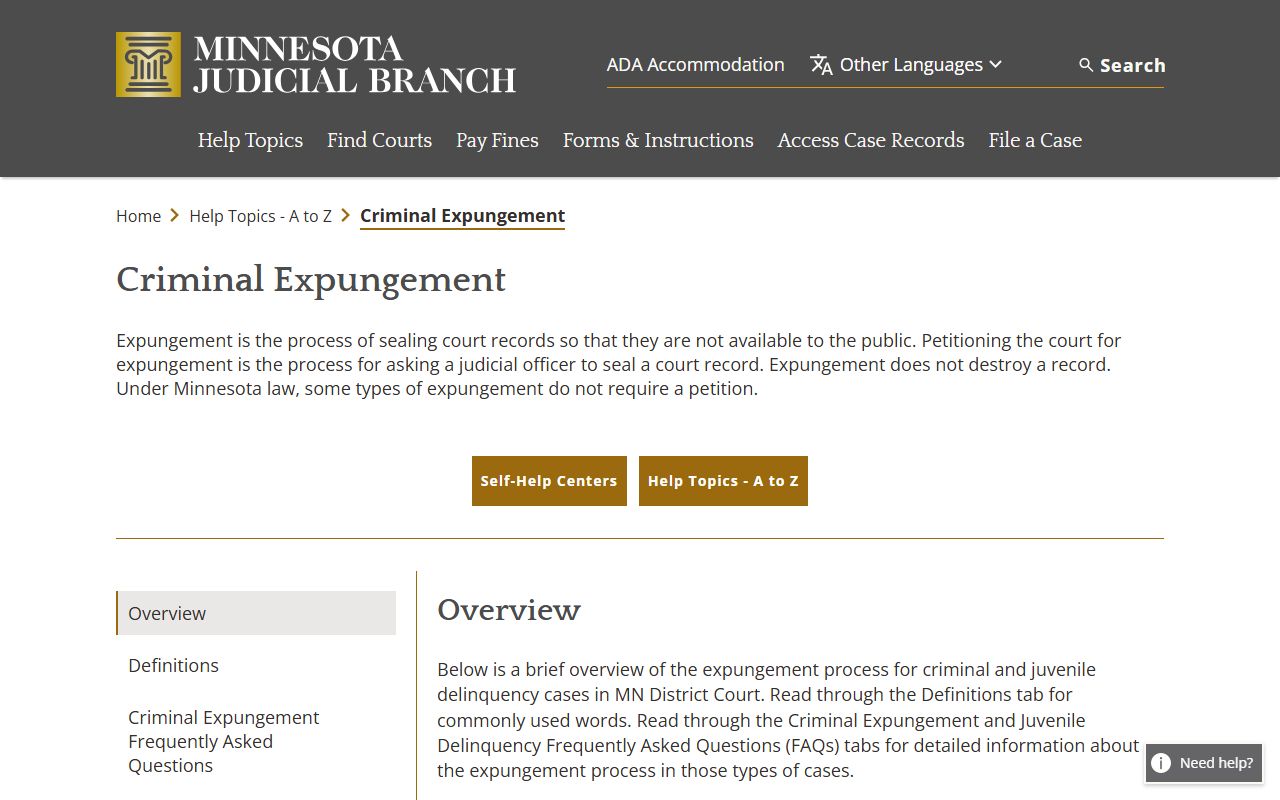
Freeborn County filing questions still go through District Court administration, but the forms and instructions are statewide.
Minnesota expungement law is collected in Minnesota Statutes Chapter 609A.
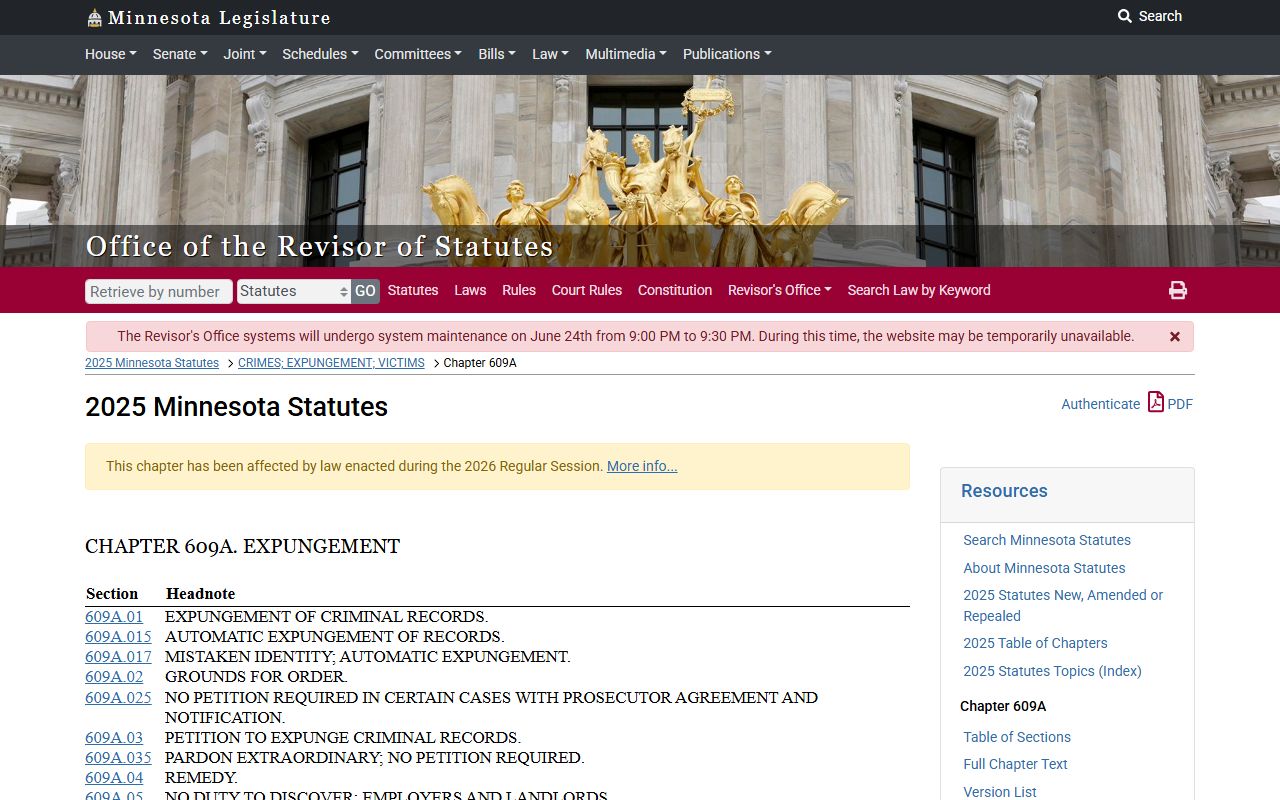
Chapter 609A is the legal foundation for petition-based criminal expungement and later access to sealed records.
The Clean Slate automatic expungement statute is available at Minn. Stat. § 609A.015.
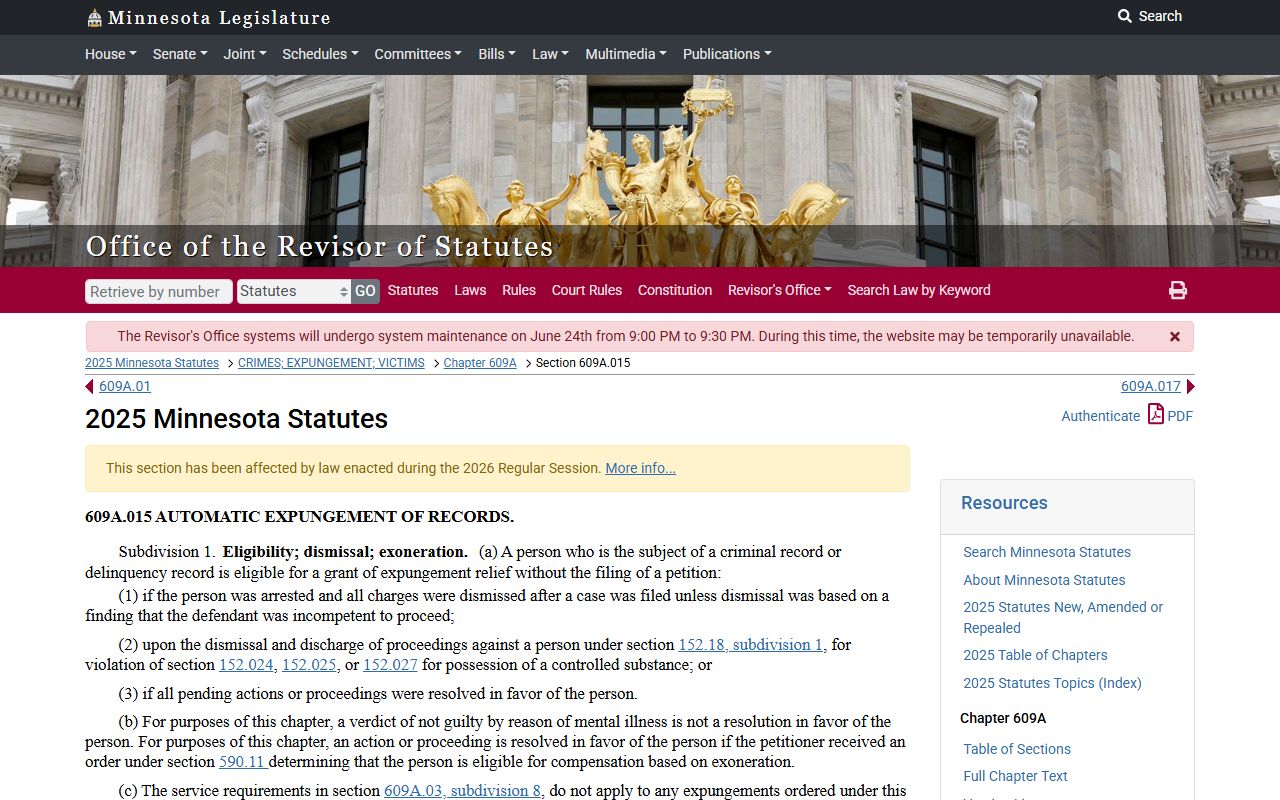
Clean Slate can seal eligible BCA records through statutory review, but petition-based court expungement remains important when court-file sealing is needed.
Public Access to Criminal Court Records
Public access to Freeborn County criminal records depends on both court access rules and data-practices law. The Minnesota Rules of Public Access to Records of the Judicial Branch govern court records. Rule 8 is especially important because remote online access is narrower than access at a courthouse terminal or court counter. The Minnesota Government Data Practices Act controls many county agency records, and Minn. Stat. § 13.87 separately addresses criminal history data.
Key Access Rules:
Minnesota Rules of Public Access - court records are public unless a rule, statute, or order restricts them.
Minn. Stat. § 13.87 - public criminal history data is handled separately through BCA systems.
Restricted Criminal Court Records in Freeborn County
Some records will not appear in a public Freeborn County criminal case search even when a case exists. Juvenile delinquency records are generally confidential, with limited public exceptions for certain felony matters involving older juveniles. CHIPS, OFP, HRO, adoption, civil commitment documents, sealed cases, and expunged records have special limits. MCRO also omits some party street addresses, comment fields, and private identifiers. If a record is missing online, the next step is to verify whether it is restricted, sealed, nonpublic, not yet filed, or available only from court administration.
For copies, call Freeborn County District Court at (507) 668-6014 or contact court administration at 411 S. Broadway, Albert Lea, MN 56007 during Monday-Friday business hours. Certified copies cost $14 under the Freeborn fee schedule; uncertified copies of available court instruments are listed at $0. Expungement first-paper filing is listed at $316 unless a waiver or statutory no-fee situation applies.
Background Check Considerations
MCRO should not be used as a complete background check source. It may show court case information that BCA conviction history does not show, and it may omit pending criminal or traffic cases from name searches when no conviction exists. BCA public criminal history is fingerprint-linked and designed for public conviction-history checks, but even that public version excludes private data. Employers, landlords, lenders, insurers, and others with FCRA-regulated uses need legally compliant background-check procedures rather than casual court searches.
Important: This site is not a consumer reporting agency and cannot be used for FCRA-regulated screening decisions.