
What Is a Court Docket in Freeborn County
A court docket is the court's running list of case events. In Freeborn County, the word can refer to a hearing calendar, the Register of Actions inside a case, or a set of docket entries showing filings and court actions over time. The daily calendar answers the practical question, "What hearings are scheduled?" The Register of Actions answers a different question: "What has happened in this case?"
Freeborn County District Court is the local Minnesota District Court trial court in Albert Lea. It has original jurisdiction over civil, family, probate, juvenile, criminal, and traffic cases filed in Freeborn County. There is no separate county court, justice court, or municipal court where ordinary local case dockets are filed. City and county matters still flow into District Court, although different agencies may be involved before or after the court filing.
Minnesota's court hierarchy is simple for Freeborn docket users. Freeborn County District Court is the trial-court location in the Third Judicial District. Appeals generally go to the Minnesota Court of Appeals, and the Minnesota Supreme Court is the highest state court. MCRO is limited to District Court records, so federal cases, bankruptcy cases, and appellate dockets are searched in separate systems.
How to Find Freeborn County Dockets Online
The main online source is Minnesota Court Records Online. Use MCRO Hearing Search for scheduled hearings and MCRO Case Search for the Register of Actions and case-level docket history. The Freeborn daily court calendar is also published by the Judicial Branch as a PDF calendar, but it is a daily schedule, not the complete case docket.
The MCRO Hearing Search page is the official hearing lookup source for this docket page.
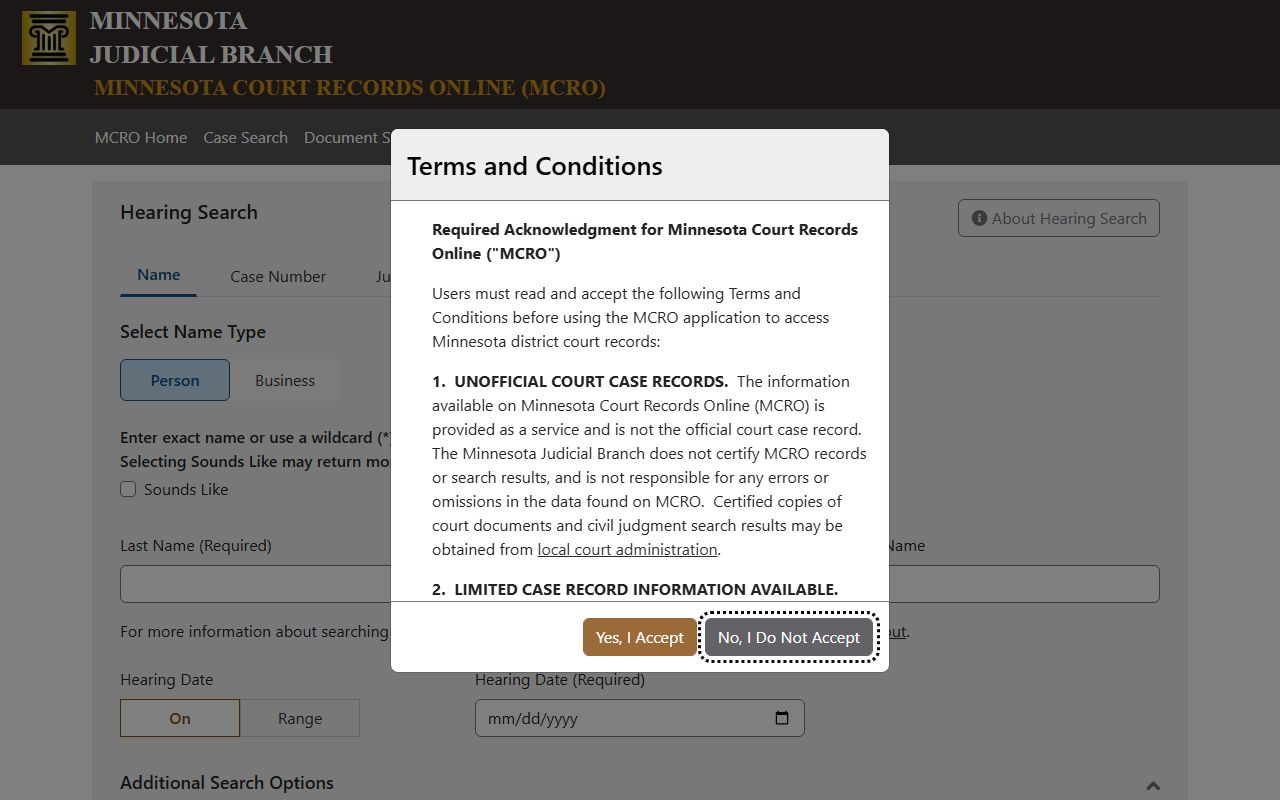
Hearing Search is useful when a person knows the name, case number, attorney, or judicial officer connected with a Freeborn hearing.
- Open MCRO and accept the terms that govern public access to Minnesota District Court case data.
- Choose Hearing Search for a court-date lookup, or choose Case Search when the goal is to open the case Register of Actions.
- Search by person or business name, case number, judicial officer, attorney name, or attorney bar number.
- Select Freeborn County in the county filter to reduce statewide results to the local District Court location.
- Review hearing date, time, hearing type, location, connection type, judicial officer, case number, and party role when those fields appear.
- Use the case number to move into Case Search if the daily schedule is not enough and the user needs the broader case docket.
- Call Freeborn County court administration when a hearing is missing, a calendar entry is unclear, or official confirmation is needed.
MCRO has an important limitation for pending criminal, traffic, and petty misdemeanor matters. If the case has no conviction, a search by defendant name may not return it. A case-number search is the better method for those pending matters. Public terminal or counter access may also be broader than remote MCRO access.
Sample Freeborn County Docket Entry
The Freeborn daily court calendar shows hearing-specific fields rather than every docket event in the case file. Research from the official daily calendar identified party names, hearing location, hearing date, time, judicial officer, hearing type, connection type, case number, and party role. Example case-type codes included PR for probate and JV for juvenile. Observed hearing types included Probate Hearing and Permanency Progress Review Hearing.
| Field | What It Shows |
|---|---|
| Party Name | Name of the person or entity connected to the hearing, when public and remotely accessible. |
| Hearing Location | Freeborn County courtroom or hearing location information shown by the court calendar. |
| Hearing Date | Date the event is scheduled on the daily court calendar. |
| Time | Scheduled start time for the hearing. |
| Judicial Officer | Judge or referee assigned to the calendar event. |
| Hearing Type | Type of proceeding, such as probate hearing or permanency progress review hearing. |
| Connection Type | Information about how the hearing is connected or attended when the calendar lists it. |
| Case Number | Minnesota District Court file number, such as a PR probate or JV juvenile case number. |
| Party Role | Role such as petitioner when displayed on the calendar. |
Absence from the daily calendar is not proof that a hearing was cancelled. Confidential cases, non-remotely accessible matters, late calendar changes, and cases limited by Rule 8 may not appear in the public calendar. A party should confirm directly with court administration if attendance, location, or connection instructions matter.
MCRO Hearing Search Fields
Hearing Search gives several lookup paths for Freeborn County court dockets. A party-name search is convenient, but it is not always reliable because names can be shared, misspelled, changed, or restricted. A case-number search is more precise and is especially important where MCRO limits name access for pending criminal, traffic, and petty misdemeanor cases without convictions.
| Field Label | Type | Required | Notes / Format |
|---|---|---|---|
| Search tab | Tab or radio choice | Yes | Person or business, case number, judicial officer, attorney name, or attorney bar number. |
| Party/person name | Text | Conditional | Searches hearing schedules by name where the hearing is public and remotely accessible. |
| Business name | Text | Conditional | Used for organization parties appearing on hearing calendars. |
| Case Number | Text | Conditional | Best method when the file number is known, particularly for pending criminal or traffic matters. |
| Judicial Officer | Text or dropdown | No | Use when searching a judge or referee's public hearing schedule. |
| Attorney name | Text | No | Useful when counsel is known and party names are uncertain. |
| Attorney bar number | Text | No | Direct attorney-based lookup by bar number when available. |
| County | Multi-select or dropdown | No | Select Freeborn to narrow statewide results to local hearings. |
Courts That Publish Dockets in Freeborn County
Freeborn County local docket access centers on Freeborn County District Court because Minnesota District Court is the trial court of general jurisdiction. The same District Court location handles civil, family, probate, juvenile, criminal, and traffic cases. That structure is different from states where a user must choose between a county court, municipal court, justice court, probate court, and superior court before finding the correct docket.
- Freeborn County District Court handles the local civil, family, probate, juvenile, criminal, traffic, conciliation, and judgment dockets filed in Freeborn County.
- The Third Judicial District provides district-level administration and program links through the official Freeborn court page, but routine case docket lookup still routes through District Court records.
- The Minnesota Court of Appeals handles most appeals from trial-court orders and judgments before possible Supreme Court review. Those appellate docket records are not Freeborn District Court dockets.
- The Minnesota Supreme Court is the court of last resort and also supervises statewide court rules and the practice of law.
- Federal district, bankruptcy, and federal appellate cases involving Freeborn County residents are outside MCRO and require federal court record systems.
The local contact point for docket questions is Freeborn County court administration at the courthouse in Albert Lea. Court Administrator Rebecca S. Mittag is listed for the court, and the published court phone is (507) 668-6014. Public counter access may show records that MCRO does not provide remotely.
Daily Calendar vs. Register of Actions
The Freeborn daily calendar and the Register of Actions are related, but they serve different jobs. The daily calendar is a schedule for a particular day and location. It helps a user find whether a public hearing is currently listed, who the judicial officer is, and what case number is tied to the hearing. The Register of Actions is the chronological docket inside a case record, showing filings, orders, events, judgments, hearings, dispositions, and other case activity over time.
| Daily Calendar | Register of Actions | |
|---|---|---|
| Primary question | What hearings are scheduled? | What has happened in this case? |
| Format | Daily schedule with hearing rows | Chronological list of docket entries |
| Common fields | Party name, date, time, location, judicial officer, hearing type, case number | Filing events, service, motions, hearings, orders, judgments, sentencing, satisfactions |
| Best use | Checking upcoming public court appearances | Tracking case progress and finding document history |
| Limit | Does not show every matter or prove cancellation when a case is absent | May omit restricted data and may not include every document remotely |
How to Read a Freeborn County Docket
Start with the case number and case type code. Freeborn examples from the calendar include PR for probate and JV for juvenile. Other Minnesota District Court case codes can include CR for criminal, CV for civil, FA for family, CO for conciliation, and TR or TK for traffic or citation-related cases. The case caption identifies the parties and their roles, such as plaintiff, defendant, petitioner, respondent, State of Minnesota, estate, decedent, or protected person.
Next, read dates in order. A docket entry may show a complaint filed, citation filed, summons issued, service filed, motion filed, hearing held, order filed, judgment entered, sentencing, disposition, continuance, warrant issued, warrant quashed, appeal filed, or satisfaction filed. A scheduled hearing row tells the user where and when to appear, but a docket entry in the Register of Actions tells what the court recorded as a case event.
Finally, account for restrictions. OFP and HRO cases are not shown online because of VAWA. CHIPS and Juvenile Delinquency Felony 16 case types are excluded from MCRO. Public civil commitment documents are not available through MCRO. Some family, juvenile, sealed, expunged, or confidential records may be absent or limited even when the court has a file. Certified copies and civil judgment search certification must be requested from court administration.